
Understanding EV Charging Station Differences
Updated: Aug 7, 2025

A Business Owners Guide: EV Charging Infrastructure
As electric vehicles (EVs) surge in popularity, businesses are increasingly recognising the value in offering EV charging solutions for employees, customers, and fleets. But navigating the different types of EV charge points and understanding what best suits your site can feel overwhelming.
In this blog, we’ll break down the types of EV chargers, their technical specifications, typical use cases, connection types, and what your business needs to consider for a successful installation. Whether you're a retail operator, commercial landlord, or fleet manager, this guide will help you make informed decisions and futureproof your infrastructure.
Types of EV Charging Stations
EV charging stations fall into four primary categories based on power output and speed: Standard, Fast, Rapid, and Ultra-Rapid. Here’s how they compare:

Standard (Slow) Chargers – AC | 3kW to 7kW
Charging Time: 6–12 hours (for a typical 60kWh EV battery)
Connector: Usually Type 2 (UK standard)
Use Case: Ideal for home use or long-stay business car parks (e.g. hotels, office blocks)
Benefits: Low cost, minimal grid impact, perfect for overnight or all-day charging
Fast Chargers – AC | 7kW to 22kW
Charging Time: 2–4 hours
Connector: Type 2 for AC; some may offer tethered options
Use Case: Common at businesses with employee or visitor parking, supermarkets, or public destinations where vehicles are parked for 1–3 hours
Benefits: Balance between speed and cost; suited for daytime charging during work or shopping
Rapid Chargers – DC | 50kW
Charging Time: ~30–60 minutes
Connector: CCS (Combined Charging System) or CHAdeMO
Use Case: Found at service stations, transport hubs, and fleet depots
Benefits: Enables fast top-ups; critical for businesses operating fleets or logistics vehicles
Ultra-Rapid Chargers – DC | 100kW to 350kW
Charging Time: 15–30 minutes (if vehicle supports it)
Connector: CCS typically, increasingly dominant in Europe
Use Case: Designed for motorway services, high-volume fleet operations, or future-proof commercial locations
Benefits: Minimal downtime; essential for high-mileage fleets or locations expecting frequent turnover
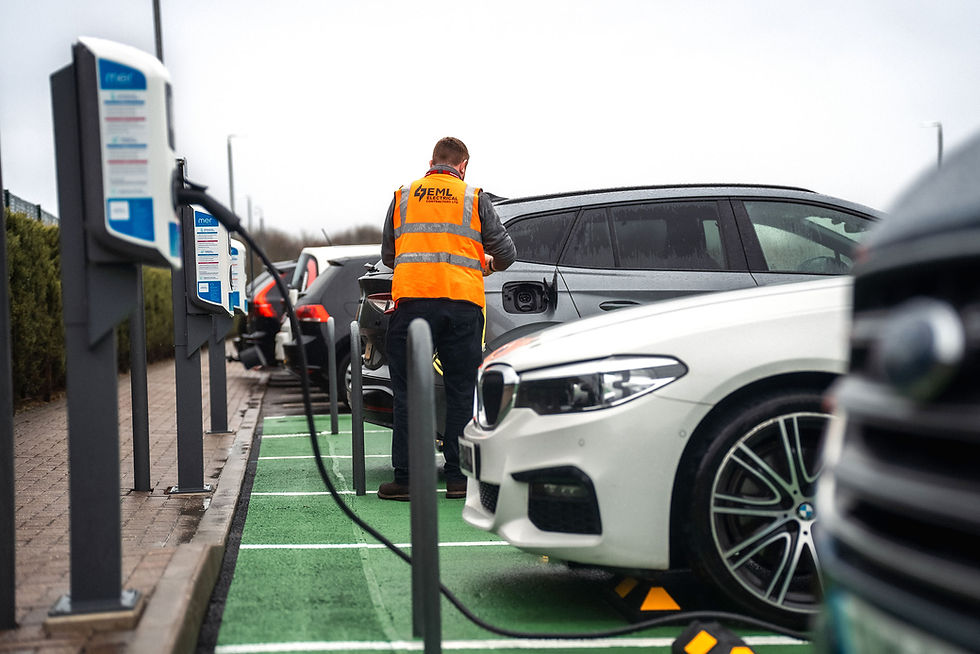
Connection Types Explained: Type 1, Type 2, CCS & CHAdeMO
When choosing a charge point, it's critical to understand the connector types and their compatibility:
Type 1: Mostly phased out in the UK, used by older EVs (e.g., early Nissan Leafs, some US imports)
Type 2: The UK and European standard; compatible with nearly all new EVs
CCS (Combined Charging System): The dominant DC fast charging connector; widely supported across European vehicles
CHAdeMO: Found on some Japanese vehicles (e.g., Nissan Leaf); slowly being replaced by CCS
Impact: For future readiness, Type 2 (AC) and CCS (DC) are your safest bets. Mixed connector stations can provide flexibility but increase hardware costs. Understanding your user base (e.g., fleet, staff, general public) helps determine what's most appropriate.
Tethered vs Untethered EV Chargers: What’s the Difference?
Both options serve the same core function but offer distinct operational and user-experience differences.
🔌 Tethered Chargers: These come with a fixed cable permanently attached to the unit. Best for fleet operations, staff car parks, and private business-use locations where vehicles are known and predictable.
Pros:
Convenient for users: Simply plug in without needing your own cable.
Faster plug-in process, ideal for sites with frequent or time-sensitive use.
Reduces risk of users forgetting or misplacing cables.
Cons:
Limited to the connector type and cable length installed (usually Type 2).
Not ideal for mixed vehicle types (e.g., if some use CHAdeMO or CCS).
Aesthetically bulkier and cables can hang loosely if not managed well.
🧳 Untethered (Socketed) Chargers: These provide a socket only—users supply their own cable. Best for public-facing installations, retail settings, and mixed-use sites where different types of EVs may connect.
Pros:
More flexible: Supports different connector types with user-supplied cables.
Sleeker appearance with no loose cables.
Easier maintenance—if a cable is damaged, it’s not part of the unit.
Cons:
Less convenient for casual users (e.g. visiting customers).
Relies on the user carrying and maintaining their own cable.
Slightly longer setup time for each session.

Building a Smarter, Greener Business with EV Charging
Investing in EV charging stations is more than an amenity, it's a strategic move towards sustainability, customer engagement, and operational efficiency. Understanding the technical differences, connection types, and use cases ensures you choose the right solution tailored to your business.


Comments